COVID-19 cases continue to grow globally, spurring ongoing debates about freedom of movement versus protecting the broader community. Meanwhile, the US continues to engage in a deeper reckoning with race, while heading towards a contentious presidential campaign season. With the tensions and confusion 2020 has brought so far (and seems poised to bring going forward), it strikes us as a good time to revisit a core part of Talentism's IP: Threat Triggers. All of us have threat triggers deeply wired into us that can hijack our best-laid plans and aspirations. These triggers helped our ancestors respond quickly to dangers, but make it hard to learn, navigate complexity and access compassion, the responses more often needed at work or trying to navigate complex issues as a community. Threat triggers tend to focus our minds on how to protect ourselves (while telling ourselves stories that often feel righteous and good), at the expense of pursuing our more thoughtful, intentional goals. While threat triggers are deeply wired, you can manage them better if you can recognize them in yourself and others. When we can actually identify the trigger that's occurring, we are better able to target our (and others') actual needs, and take our "bad / stupid / lazy" narratives a little less seriously, creating more space for understanding and effective action.
THINK
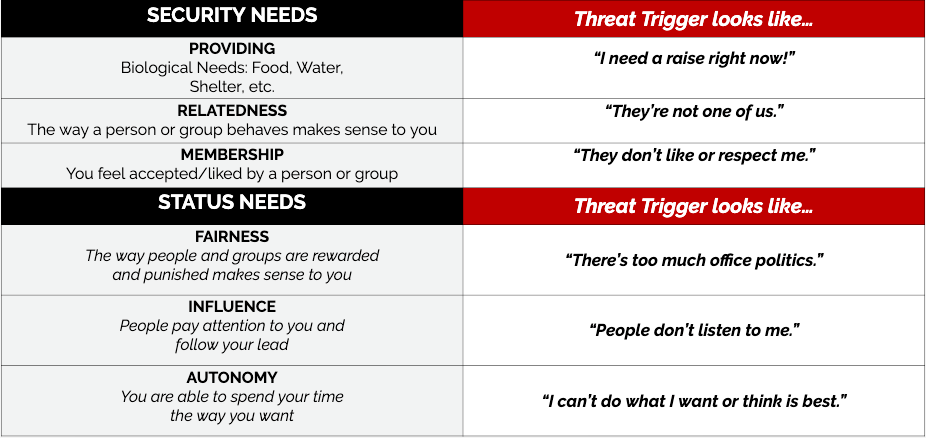
All living organisms are concerned with two things: surviving and procreating. With humans, as with all social animals, those two can get intertwined pretty heavily, but loosely shake out to two separate areas: Security and Status. Each has a few distinct flavors.
The most basic level of security threat is physical. Hopefully this pops up rarely in business, much less one's life in general, but it is a threat trigger that physical harm will actually come to you. Aside from physical threats, the other threats to survival are food, shelter, and a feeling of safety (which manifest often as "wanting to stay where its comfortable").
Providing is the threat triggered when you worry that you will not be able to provide yourself those things. Humans, being social animals, can also feel those needs for others (i.e. "providing for your family").
Worries about safety led to the need of all animals to be able to identify like from unlike — things that will attack versus those that won't, things that might carry disease versus those that won't, things that will threaten your food supply vs those that won't, etc. They did this through determining relatedness. In humans, this shows up in tribalism, i.e. in-group / out-group dynamics.
Last is membership. With social animals (including humans), group excommunication can be a death sentence in the wild. Because of that, we have developed a natural sensitivity toward other people's attitudes toward us. When you see people being conflict avoidant, or people pleasers, or worried about delivering tough feedback, this is usually a membership trigger at play.
Status triggers in humans are complicated because of the near eusocial nature of human existence. But even we have a basic status trigger that most if not all animals have: autonomy. This is a basic desire to be able to do what you want to do, extending to a desire for free movement and ability to sculpt one's environment. In humans, this is popularly associated with "alpha male" behavioral patterns (though of course all humans can do this depending on context).
A bit less common than autonomy-based status threats are threats to status as influence. For autonomy, this is being able to do what you want; for influence, it's being able to make others do what you want. In the office, an influence trigger might show up as micromanagement, as people try to pressure others into behaving a certain way
Both of those have mostly to do with power dynamics. But there's a social status-based categories as well: fairness. Humans have a basic sense of what is fair and unfair as far as rewards and punishment go. People have an expectation of an outcome for themselves or others with regard to reward or punishment, and if that is not met, it is thought to not be fair, inducing a threat state.
REFLECT
- Think about the last time you got really stressed out (or your current stress, if it's present). What is the situation? Does it fit into one or more of the categories described in the write-up? As a reminder, these include:
- Physical security
- Providing
- Relatedness
- Membership
- Autonomy
- Influence
- Fairness
- By identifying the potential root cause of the trigger, do you notice any
- Changes in how you feel?
- Ways in which the situation looks different to you?
- How are you currently dealing with the situation / stress?
- If you've identified the potential root cause of the trigger, do you see other ways to attend to the trigger more directly?
TRY
- In a doc or a notebook, spend the next week tracking your triggers. They don't have to be big things, just moments where you feel some stress coming online. Briefly note:
- What happened (just the facts)
- What feelings / sensations you experienced
- What thoughts / narratives about the situation arose
- Take a look at the triggers at the end of the week. What common threads do you see?
- Reflect on the most common sources of stress in your life. Do they correspond to the same threat triggers you've noticed via this tracking exercise?
- Once you have some hypotheses for your main threat triggers, brainstorm a few specific actions you can take to address them directly.
- For example, if you think autonomy triggers have been getting you into trouble with other executives lately, the next time someone comes with a proposal that irritates you, you could try getting clear on the specific expectations they have for your participation before arguing the merits of the idea itself.
- Put a few of these experiments into place, and track if they make a difference.