Our purpose at Talentism is systematically unleashing human potential. In our society, the main place people come together to achieve goals cooperatively is at work. Helping people get clear in their work so they can continually evolve toward accomplishing more meaningful and complex goals together is the key vector through which we deliver on our purpose. We have numerous frameworks for helping leaders, managers, and employees make sense of their own minds and the world around them. One of the most fundamental of these models, especially in an organizational context, is what we call The Enterprise Clarity Model (ECM, given our compulsion for making acronyms). In today's Sensemaker, we introduce the four main components of the ECM. In future Sensemakers, you can expect deeper dives into each of these areas.
THINK
The key areas to clarify for a successful organization
Businesses exist to achieve goals. All of us have expectations about what we're doing; whether those expectations are clear or muddled is a key differentiator between successful and unsuccessful organizations, given the outsized role of confusion in human performance (read more about confusion here).
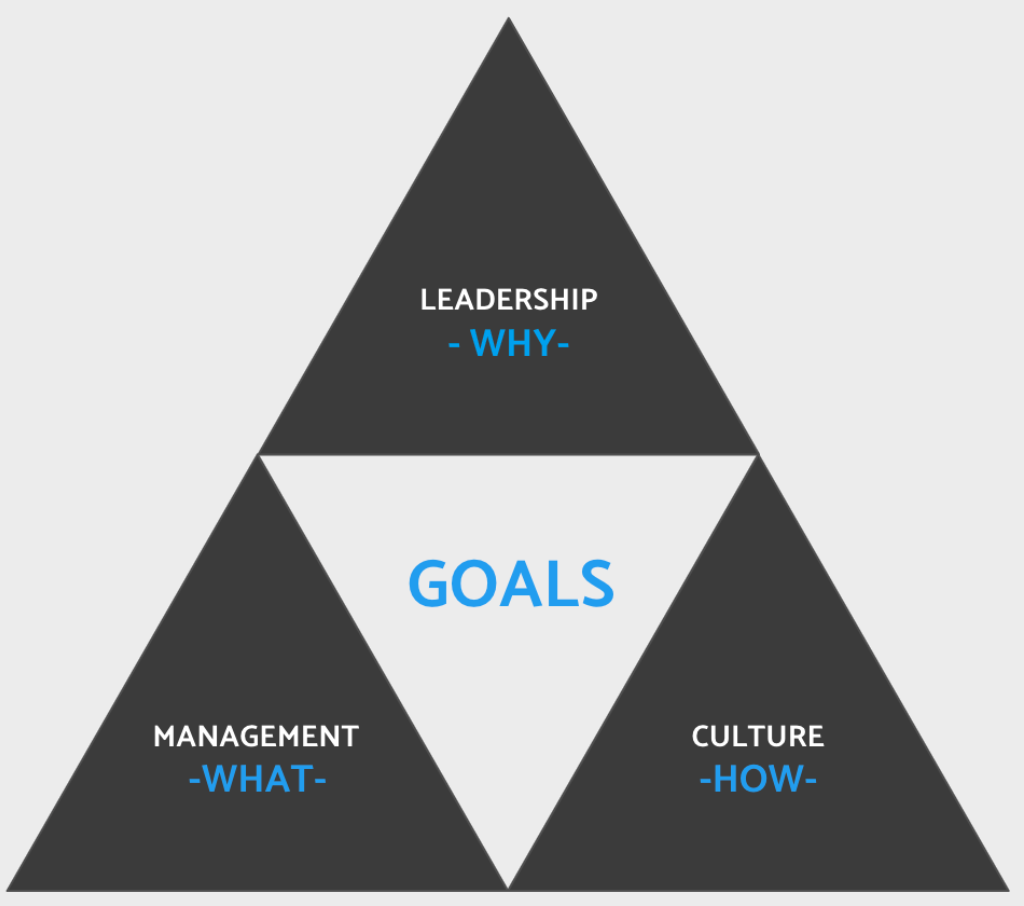
The Enterprise Clarity Model is Talentism's model for the key areas of context in a business that need to be continually clarified for people to work effectively together.
Goals: Meaningful results that you work towards over time.
All businesses exist to achieve goals. If a company doesn't clearly know its goals, then by default its goal is to survive.
There are many different frameworks for setting and tracking goals. From what we've seen, it matters less what specific framework you use, and more that you're setting and referring to goals consistently. That said, we've found that any good goal-setting approach needs to address three key areas:
- Describing the goal: What, specifically, needs to be done? Can everyone name the goal? Does everyone have a shared understanding of what it means?
- Connecting to the goal: Why does the goal matter? How do individual employee goals (or department goals) roll up to larger enterprise goals?
- Measuring progress: How is success being tracked over time?
Goal clarity is essential because it allows people to focus their attention and energy on a shared set of outcomes. When there's confusion on goals…
- People direct efforts at different targets, sometimes at cross purposes. This makes it easy to view others in the company as threats, creating ripples of protection behavior.
- People divert resources to their own goals at the expense of others.
- People expend energy ineffectively, unknowingly focusing on the wrong priorities.
- People lose motivation to perform because they don't know how their contributions make a difference.
You can read more about how Talentism thinks about goals here.
Leadership: The act of defining and clarifying the future for others to create.
Leadership helps people understand WHY they are pursuing their goals.
Excellent leadership requires clarity in 3 areas:
- Vision: A statement of the world the company is trying to create. For example, Talentism is "creating a world where everyone is able to unleash their potential." LinkedIn is "connecting the world's professionals to make them more productive and successful." TripAdvisor is "helping people around the world plan and have the perfect trip." These are simple statements that help people understand what their efforts add up to. Visions don't necessarily have to be idealistic or altruistic — in fact, touting an idealistic vision that doesn't actually match the reality of what the company does is a recipe for confusion. Amazon's vision, for example, is "to be earth's most customer-centric company; to build a place where people can come to find and discover anything they might want to buy online." Note that this vision is inherently one of dominance — to be the singular point of retail access for anything someone might want.
- Meaning: It's not enough to merely establish a vision — leadership is required to help people understand why that vision matters — why a world in which the company is successful is something you should care about. Meaning differs for people, and as such different companies will offer different meanings to people. Some companies just exist to make money or perhaps provide security for their stakeholders. If that's what makes the company's vision meaningful to its employees, great — what matters from the perspective of reducing confusion is that it's clear and meaningful to the kind of people who will find it home.
- Trust: Do people believe that leadership will lead the company to successfully manifest its vision? This isn't (necessarily) about being liked — it's about people believing their leaders have the compulsion and mastery to keep everyone aligned with the company's reasons for existing. If you're a leader, why should someone follow you?
Leadership confusion often manifests as…
- Difficulty getting in sync on defining goals, which creates existential dilemmas (why are we here?).
- Inconsistent understanding across the enterprise, which diminishes trust, commitment, and effort.
- The lack of a clearly articulated vision, which creates a ripple effect of confusion around management and culture.
- The lack of a strong unifying foundation, which causes business functions to operate in silos.
Management: The act of accomplishing goals through the work of others.
Management defines WHAT people do to accomplish goals.
Management is in many ways the most critical area of the ECM, as it's the primary mechanism through which goal, leadership, and culture clarity are continually reinforced (and confusion recognized early). It's what enables organizations (and people) to continue learning — transforming inevitable confusion and performance gaps into the compounded learning that leads companies to succeed, especially through periods of high change. By ensuring everyone stays in sync around goals and designs, catching confusion and problems early, and resolving them appropriately, great management makes it possible for people to spend their energy reaching goals together, rather than spending that energy making sense of each other and their environment.
There are a variety of different approaches to management. However, clear management requires the following responsibilities to be met excellently in one way or another:
- Design: How are responsibilities and processes structured to achieve goals? This requires a clear visualization of what needs to be done to achieve a goal, the talents required to successfully fulfill those responsibilities, and an understanding of the processes that will enable coordination across those workstreams.
- Employ: Putting the right people into the right roles in the Design to achieve the goals. Sometimes this will require people outside the organization (hiring), while in other cases it will be a matter of reshuffling responsibilities within (or across) teams.
- Clarify: Ensuring ongoing awareness and understanding of the goals and Design, as well as the broader cultural requirements for delivering on them.
- Investigation: Proactively gathering evidence of how the Design is working (or not) to achieve the goals.
- Diagnosis: Turning confusion into clarity by taking the output of the Investigation (comparing goals and Design to outcomes) and determining the source of the gap (if any).
- Evolve: Consistently using the findings from Diagnosis to iterate on the Design or allocation of people (Employ) to better achieve the goals.
When there's confusion on management, you'll often see…
- It's hard to get work done. Confusion escalates as basic execution tasks spiral into endless rounds of talking-past-each-other.
- Analysis paralysis and duplicate work occur, as no one knows how and when to move forward.
- The wrong performance problems are being addressed the wrong way, wasting time and energy.
- Ineffective hiring, talent management, and succession planning strategies lead to poor decision making.
Culture The expectations of rewarded behaviors and outputs in an organization.
Culture is people's understanding of HOW they should accomplish their goals.
Talk about culture is pervasive but the word is often ill-defined. At Talentism, define culture as people's expectations about what behaviors are rewarded, punished, and allowed. Rewards often take the form of promotions, raises, or public praise. Punishment typically takes the form of reprimands, demotions, or criticism.
For organizational contexts, we break these expectations down into three key buckets:
- Norms: Expectations around behaviors in organizations. Companies may reward star achievers or team players. People who take initiative, versus those who stay in their lane. Norms include both how people work and how people show up in the work environment — e.g., "leave your personal life at the door," versus "show up with your authentic self."
- Standards: Expectations for work products and outputs. Companies often hold different standards around speed versus quality, or what it means for a product to be "finished." Is "finishing" about pursuing beautiful and cutting-edge design, like at Apple? Or including as wide a variety of features as possible? Standards define people's general thinking about what "good" looks like for the output of their work.
- Speed of Change: Expectations around how fast things will change. How important is change to winning? Does the company exist in a stable market with a defensible moat? Does the company require ongoing iteration?
Culture confusion can be especially corrosive, as it can amplify small, everyday occurrences into larger sources of conflict and uncertainty. When there's culture confusion in an organization, you'll often see…
- Seemingly trivial interactions put people into threat.
- People drive to protection behavior, as it becomes easier and easier to form negative narratives explaining the behavior of coworkers.
- Formation of "camps" around different subcultures who see protecting their own resources as the goal, at the expense of others.
- Perceived hypocrisy of "do as I say, not as I do," which erodes trust and commitment to goals.
You can read more about how we think about culture here
REFLECT
- How clear are each of these areas in your organization?
- Where have you personally experienced or witnessed the most confusion around these areas?
- What consequences have you seen from misalignment or persistent confusion in these areas?
TRY
- Take a moment to write down a few sentences for each of these areas within your organization. Don't worry about it being perfect — the aim is to stimulate reflection on any underlying confusion that may not have been immediately apparent.
- Write down your level of confidence for whether others on your team would answer the same way.
- Invite others on your team to do the same. Don't share your answers with them before they do the exercise.
- Set up time to compare what each of you wrote. How aligned (or not) are you? How do the answers and alignment compare with what you expected?