In today's Sensemaker, we're reviewing a concept foundational to our work at Talentism: Clarity.
Last week we covered the foundational Talentism concepts of confusion and certainty. This week's Sensemaker will be building directly on that foundation, so if you haven't had a chance to read that yet, check it out here before reading today's Sensemaker on clarity.
Helping people achieve clarity in commercial contexts is the heart of what Talentism does. This is because the ability to turn confusion into clarity (rather than certainty) is the fundamental requirement of active learning and, thus, achieving potential. As a leader or manager responsible for achieving big goals through the work of others, it's essential to learn how to create clarity for both yourself and those you work with. Every big goal that seeks to create something new in the world will inevitably run up against confusion. Continually returning to clarity transforms that confusion into fuel for growth rather than cause for fragility. Choosing the path to clarity is, in the end, what distinguishes leaders and organizations that win from those that fail to achieve their potential.
THINK
Turning Confusion into Active Learning Through Clarity
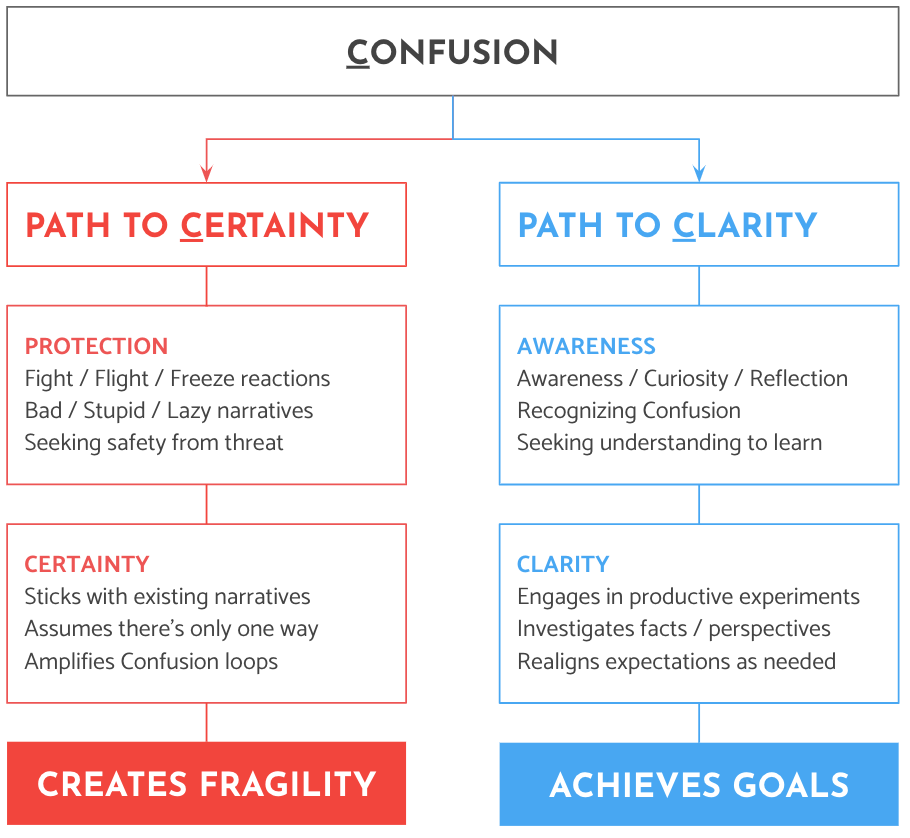
If confusion is the state we enter into when reality doesn't match our expectations, clarity is the state of purposely updating our expectations to understand reality and act on it toward our intentional goals. Whereas the path to certainty sees us make sense of our confusion by seeking to protect ourselves and our existing worldview, clarity, by contrast, is the open-minded process of making sense of our confusion by updating (rather than retrenching) our view of ourselves and the reality around us. The goal, in other words, is to meet the unexpected with intentional learning.
The first step toward clarity is simply habituating awareness that you are confused. When we pause, even just to be aware of our own confusion (and better yet, to voice it), we can start to learn more about ourselves and the world around us. It requires transitioning from the question we tend to implicitly ask ourselves under threat — "why are others wrong?" — to the question "what am I missing?"
Remember, confusion shows up any time there's a gap between reality and your expectations. The sooner you catch it, the easier it is to transform into clarity. There's a good chance that if you're confused, others are as well, so it's almost always the right move to step back and inquire if you suspect that expectations aren't lining up to what you (and others) are experiencing.
Some potential signs you're getting confused:
Mind signs
- Expectations weren't met
- Someone's saying something that doesn't make sense to you
- Don't know what to do
- Need to take a stand on something (or avoid it)
- Trying to make a case
Emotional signs
- Fear
- Anger
- Overwhelmed
- Zoned out / disengaged
- Uncomfortable
- Anxious / Fidgety
Once you've become aware of your own confusion (or that of others), you can open the door to curiosity. The key here is to identify the gap to expectations and how that gap is distorting your thinking. Key questions include:
- What expectations did you have that weren't met?
- What feels at risk?
- What assumptions are you relying on to orient yourself?
- Where are you more focused on defending yourself (or an idea) than learning?
Because clarity requires both updating your mental model and narrowing down your field of vision to what matters most for effective action-taking, you need to use your awareness to reorient to your intentional goals. Good prompts to use for yourself and others to reorient include:
- What's the vision here?
- What goals need to be achieved to bring that vision into being?
- How do your initial expectations limit your ability to see other paths to that goal?
- What else are you confused about that muddies the path to that goal?
- What have you learned about yourself that may hinder your ability to reach that goal?
- Given that picture, where may you need help or an alternate design for achieving it?
This isn't just a mental exercise; it requires checking in with others and actively experimenting to both update your mental model and try new shots on goal. This could take the form of:
- Aligning on expectations with teammates
- Trying new things and reflecting on what you collectively learn from them
- Checking in with key stakeholders (like customers or other departments)
- Being open to your own weaknesses and working to mitigate them through changes in design
Put all together, the model looks like this:
REFLECT
Take a moment to think about your own work:
- When was a time you were wrong about someone or something at work?
- How did you find out?
- What did you learn?
- What was your response?
- When was a time you discovered a major blind spot in yourself?
- How did you find out?
- What did you learn?
- What was your response
- When was a time you found a win-win solution to a problem that had seemed previously unsolvable?
- How did you get there?
- What had you been missing that had made the solution hard to see earlier?
TRY
Commit to the following experiment. For the next two weeks, every time something you're working on with someone else doesn't go the way you expect (or otherwise confuses you), do the following:
- Say "I'm confused"
- Name what you were hearing and what you were expecting
- Restate your most important goal
- Ask the person involved (or yourself, if they're not available) "What am I missing?"