THINK
Goals and Goal Confusion
Now that we're a month into the new year, many of our clients are deep into their 2020 planning. Because goals provide the foundation for most planning approaches, I thought it would be valuable to share a Talentism-eye view on goals and the kinds of confusion that can prevent them from being achieved. Given the centrality of goals in coordinating action, there exists an alphabet soup of different ways to define and track them: FAST goals, SMART goals, OKRs, KPIs, MVPs, Sprint goals, and so on. Different systems for defining and tracking goals work for different companies in different contexts, and from our experience, the underlying system is less important than how it's actually used to maintain sync and uncover problems as they occur. Given that perspective, the following piece covers the core features of good goals (as set through any particular system), and more importantly, the key lenses for checking that you and your team are actually in sync on what they are and how they'll translate to behavior.
Goal-setting is one of the most important elements of business, and poor goal-setting is often the root of many problems down the road. How do you keep a group of people in sync despite constant entropic forces? You must have conversations about who is going to do what by when. Because confusion occurs as the result of gaps between expectations and reality, goals are the fundamental building block of creating shared expectations for the team. While Vision is the ultimate (and perhaps unreachable) state we want to get to, and Purpose is why we want to get there, Goals are the commitments we make to each other about what we are going to do, by when, and how we are going to do it, so we can stay in sync (ie out of unproductive confusion).
At some level, a goal is simple — it's a specific, future outcome a team is committed to achieving, that moves the ball forward on the overall vision of the company. Each of these elements is critical; goals need to be explicit outcomes achieved over a specified amount of time, with measurable checks for success, that have everyone involved genuinely committed to reaching them.
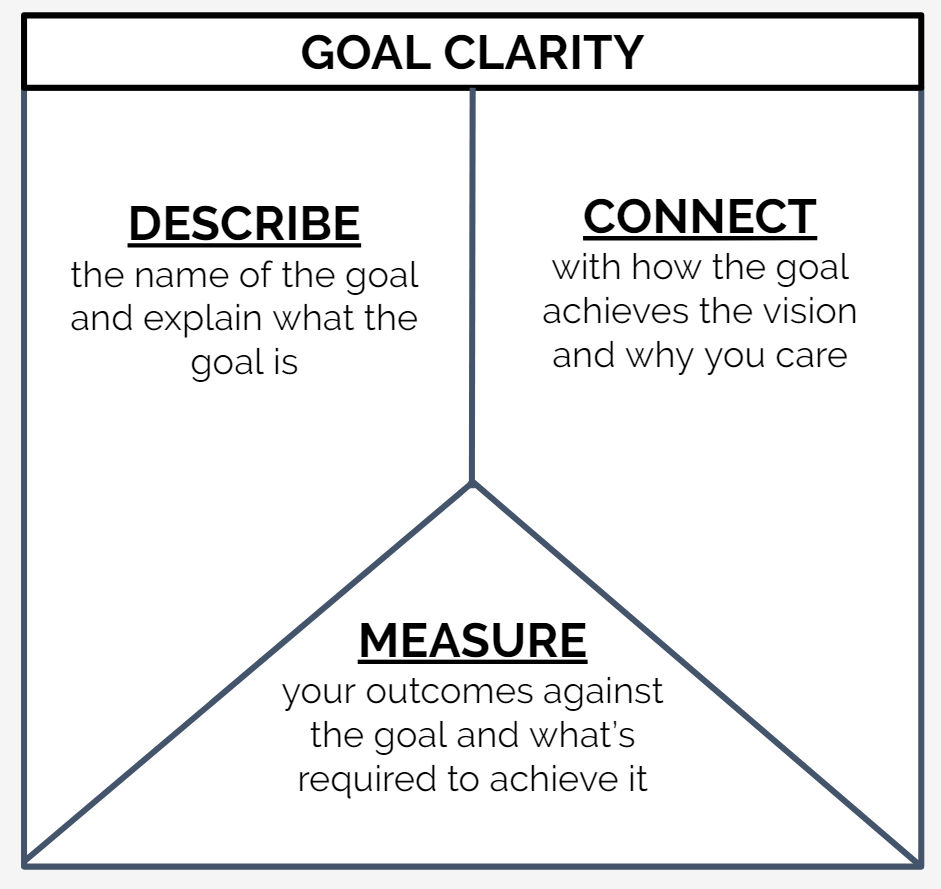
When evaluating a goal, the first test it has to pass is whether it effectively communicates all three of the core ingredients above. Questions you can ask yourself include:
- Describe: What is the goal? Is everyone who hears the goal clear on the terms involved and what they mean? What level of abstraction does it represent (e.g. is it a simple goal that can be handed off with little explanation, or a complex goal that requires further sub-goals to be implemented)?
- Connect: How does the goal matter to achieving the greater vision for the company? If the company fails to achieve the goal, what is the impact? If the goal is achieved, what does it make possible? "Connect" means being able to connect it to the vision, but also yourself; do you actually care if the goal is achieved? Why should others?
- Measure: How will you know if the goal is accomplished, or not? What outcomes specifically indicate that the goal was achieved? What steps are necessary to know if you're on track to achieving that goal? Without measurement, you can't crystallize problems, because problems, ultimately, can be defined as gaps to goals. Without clear measurements, you can't actually define gaps beyond people's feelings that they believe something is going wrong.
Goal Confusion
Even if a goal contains these three ingredients, significant confusion is still possible (and likely). At Talentism, we believe confusion can show up at 5 levels of depth. Genuine goal clarity for a team means clarity across all five of these lenses:
- Awareness: This is the most basic level of goal sync. It means everyone involved in achieving the goal knows the goal exists and can name it. For a product team, it may sound something like "launching our new product with an improved user experience by the second quarter of 2020." Clarity at this level means that you should be able to ask everyone what the team needs to achieve by the second quarter of 2020, and they'll give you the answer quoted above.
- Understanding: If people have meaningfully different interpretations of the goal itself, it's easy to get out of sync. In the example above, people may have widely different understandings of what an "improved user experience" means. What are you asking about the user experience, exactly? How is that call being made, and how does it contribute to the larger goals of the company as a whole? How will you measure improvement so you can demonstrate it has occurred? How much improvement is required? In other words, what are the standards for achieving that goal? Confusion at this level may show up as everyone agreeing they know the goal, but missing each other when it comes to decision making, or arguing in ways that result in conflicting understandings and interpretations of what the team is trying to achieve. Clarity at this level means you can have an open discussion with the team about the goal and what it is going to take to achieve it, and each member can come to a shared understanding in their own language.
- Alignment: Goal alignment means being in hard sync with the person creating the goal (and your manager, if it's a different person) that this goal is where you should focus your efforts. Alignment means you and your manager are in sync with how you prioritize your work, and how your performance will be evaluated with that goal in mind. Confusion at the goal alignment level can sound like "I know improved user experience is supposed to be my focus for this quarter, but my manager always asks me to work on something else." Because alignment confusion often takes place at the level of prioritization, it typically requires you to sync upwards to the vision and strategy levels, and sometimes, a reevaluation of the original goal.
- Care: Even if people know, understand, and are aligned with others on a goal, they may not genuinely care about it enough to see it through. This can occur for a number of reasons, but the most easily fixable is a lack of clarity about how a goal connects to the company's purpose — or other outcomes — that the employee finds inherently meaningful. Willpower is a poor fuel source. Unless people find personal meaning in the goal they are compelled to achieve, it can be easy to unconsciously de-prioritize it when things get hectic or difficult. This level of clarity depends more on what an individual is like than the other lenses. Someone on the team with a commercial bent may not understand why improved user experience is important without seeing how it's critical to the company's competitive strategy and the key to exponentially increasing market share. Someone else may not find it an interesting problem until they get deep into the complexity of how users interface with technology and possibilities there. Confusion here can be dangerous if people are unwilling to be honest with themselves and their teammates about what really drives them. At its worst, breakdowns here can look like people fighting for the part of the goal that's important to them to the detriment of actually achieving it, or simply not delivering and making excuses.
- Trust: If people have clarity across all the other lenses discussed above, they can still be out of sync with the goal if they don't trust their teammates and/or managers to work with them towards achieving it.
REFLECT
Awareness
- Can you name your team's goals?
- Can you name how their achievement will be measured?
- Can you name when they need to be achieved by?
Understanding
- What do your team's goals mean in practice?
- Do you and your teammates hold the goal in the same way? How do you know?
- Are there any implicit assumptions about what the goal means that need to be made explicit for everyone to understand?
- Are there difficult-to-measure factors (e.g. quality) that are an important part of the goal? How are those being communicated and defined?
- What sub-goals must be achieved for that goal to succeed? Are people in sync about those sub-goals?
Alignment
- Do your coworkers share the same view of your goal?
- Are you clear on how important each of your goals are in relationship to one another?
- Does your team prioritize its workflows in relation to achieving the most important goals?
- Are there other, unspoken goals that often take precedence over the goals you believe are primary?
- Is achieving your explicit goals a major part of how you (and your teammates) will be evaluated in your roles?
Care
- Do you actually care about whether or not your goals are achieved?
- Do you care about whether your department and company goals are achieved?
- If you can't connect to the goals themselves, can you imagine what is at stake if they fail? Is there anything about accomplishing the goal that feels meaningful to you, even if it's not the goal itself?
Trust
- Do you trust your team to face these goals together?
- When thinking about blocks to those goals, do you notice a voice of blame coming up, or concerns that the work will be wasted?
TRY
- In the next meeting you have involving goals, probe for sync across the lenses described above:
- Can everyone describe the goal in their own words?
- Can everyone speak to what it means in terms of prioritization and behavior?
- Can everyone voice why it matters both to the organization and them personally?
- Does everyone trust the team to tackle the goal together?
- If you run into a block at any of these levels, discuss what would need to be true for everyone to get into sync, eg:
- What else might people be valuing that the goals don't cover? Why? Do those additional concerns need to be incorporated into new goals, or do they change how the current goal is framed?
- What tweaks would need to be made to the goal to have people care and trust its implementation?