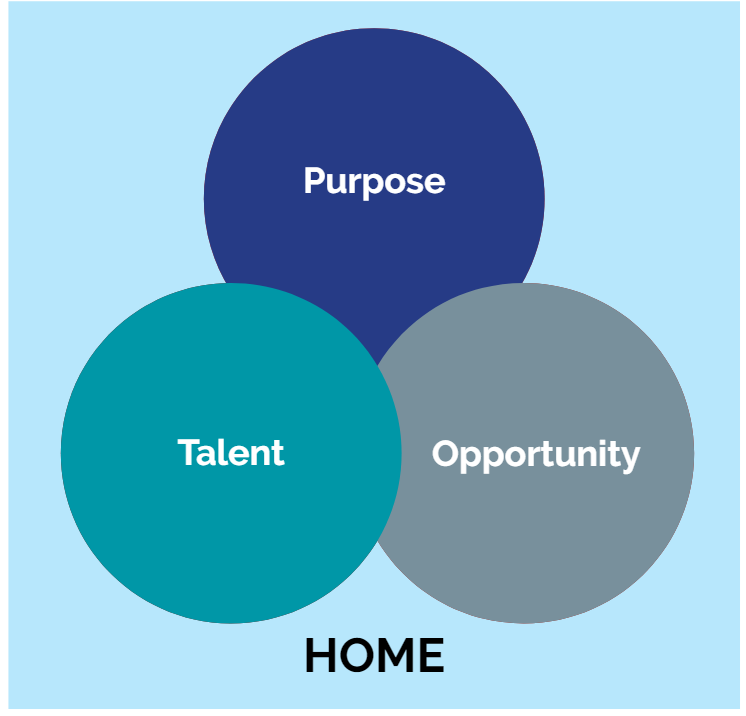
Our purpose at Talentism is systematically unleashing human potential, starting in commercial contexts. A core part of this purpose is helping individuals align their goals and responsibilities with what they are like (and helping managers do this with their employees). Our primary framework for this alignment we call "the Big 4", comprising Purpose, Talent, Opportunity and Home.
THINK
Purpose: Purpose is a big topic, and many of the world's best minds throughout history have devoted themselves to understanding what it means for a person to live a purposeful life. Our definition for Purpose in a work context, as with the other elements of the Big 4, is designed to be discoverable through evidence, so that you can learn about it experimentally. In our definition, Purpose-aligned work is the work you exist for, that keeps you going when it gets hard, which all work eventually will.
We break Purpose out into two key components: Compulsion and Meaning.
Compulsion is that thing you can't stop. It's those things that you don't need to summon willpower for; the ideas you can't get out of your head, the activities you get lost in. It's what drives you to keep moving forward even when everything else tells you to stop. While we often relate to compulsion as a bad thing (and there's no shortage of self-destructive compulsions), there are very few examples of people who achieved great things who didn't have a compulsion for the path that got them there.
Meaning is how you relate to the outcomes of your compulsion. The outcomes have to give you a sense of place in the world by virtue of what you do. Meaning is the fuel that keeps the compulsion going — what makes the work ultimately worth it. Generally, meaning has one of two components: the impact of your work benefits someone or some group you care about, or you have solved a difficult problem.
Compulsion
- The idea you can't get out of your head
- The thing you can't stop talking about
- The thing that you can't put down
Meaning
- An outcome that feels good to you
- Makes you feel like you have a place in the world because you did that thing
- The fuel that keeps the compulsion going
- What makes the work worthwhile
Aligning work with Purpose is critical for unleashing both your own potential and that of your team. Without Compulsion, action and attention will be limited by willpower / external prodding, which are rarely sustainable and end at "good enough." Without Meaning, we become increasingly confused as our accomplishments leave us empty.
Connecting work to purpose will be an ongoing process. It's not about "finding your passion" or "loving what you do every day." Rather, Purpose in work and life is something we align with more and more through our commitments; taking on responsibilities from which we derive satisfaction but with which we can never be satisfied, because the bar for excellence goes yet higher. It is about channeling the areas in which we are most restless, most uncompromising, most obsessive, into the acts that offer the fulfillment to get up and do it again.
As a manager, understanding the underlying purpose drivers of your employees (and helping them understand them themselves) is a critical part of your success. In our coaching work, we often diagnose failures back to a lack of alignment between goals and purpose. I recently worked with a founder who started their company because of their love of creating things and the lure of a big IPO, who was puzzled when they struggled to manage their company through a new period of required operational improvements and the realities of a smaller addressable market than they initially imagined. They found themselves daydreaming about their next company and churning through one executive after another when outcomes disappointed. In this case, the CEO's lack of purpose alignment with what the company needed limited their ability to hire well, manage their new executives, or help reorient the company — because when it came down to it, they didn't really care about what the company had become. Without recognizing purpose misalignment as the underlying cause of the failures they were seeing, it would be easy to keep diagnosing the problem as one practical issue or another, while paying the opportunity cost of other ventures where they could actually express their greatness.
While every job has aspects that won't be aligned with our purpose, if the core requirements of our role are persistently misaligned with it, it will be monumentally difficult for us to deliver to our potential. Conversely, the more your responsibilities and purpose come into alignment, the more you will shine — often further and faster than you ever knew was possible.
REFLECT
Think through the following thought prompts:
Compulsion:
- You just realized it's way past your bedtime, and you have been up doing / reading about / writing about / researching / tinkering with.. what?
- When you start talking to your friends / spouse / colleagues about this, they groan, roll their eyes and say "not this again" (but listen to you anyway because they love you)
Meaning:
- Think of as many examples as you can of times when you did something, perhaps even toiled over it, and when you finished it, you said, "Wow, that felt good. I'm so glad I did that." If you get stuck, think about cases of problems you solved or people you helped, as these are often areas where people experience meaning in their work.
- Why? What is it about each example's outcome that created that sense of elation? What kind of impact did it have on you or others?
- What has been consistently on your mind since what feels like forever ago? Not just the last few months, but the last few years? Maybe the last decade?
TRY
- Write down as many answers as you can for the thought prompts above. Don't worry about evaluating them — just put them down on paper.
- Ask others in your life who know you well (parents, partners, mentors, long-time coworkers, friends, etc.) what they hear you talk about / obsess over.
- Look across the examples. What themes emerge?